Electrician answering service for sparks, outages and panel jobs
Forward your line after hours, on weekends, or when the whole crew is out on jobs.
3 days free, then from $149 a month. Cancel before day 4 and nothing is charged. During the 3-day trial: 150 minutes, up to 8 minutes per call. Call the demo line: (973) 791-7808
Your phone rings while your hands are inside a live panel. DispatchLine answers your business line, tells a caller with a hot outlet what not to touch, asks whether a breaker has tripped and whether the whole house or one circuit is out, and puts the job in an arrival window on your board. Panel upgrades, EV chargers and generator installs come in as leads, with the answers to any estimator questions you add in the portal.
How our electrician answering service sorts each call
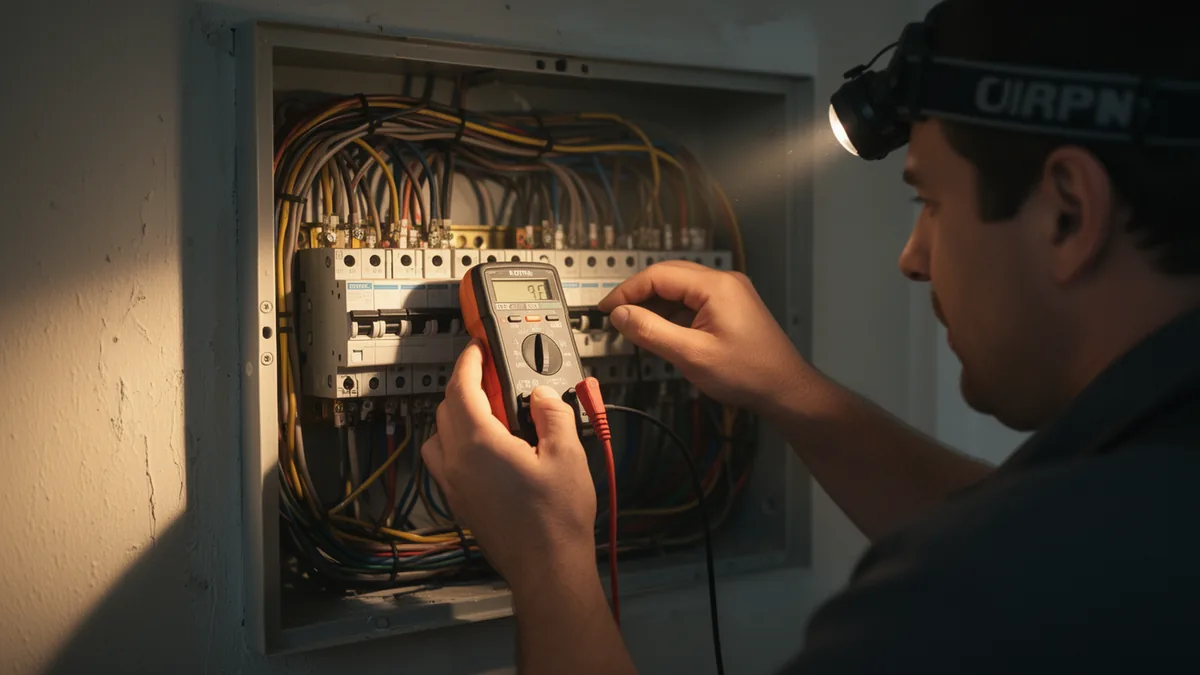
Every electrical call splits at one question: is something happening right now, or are you planning work? A caller with a burning smell answers that at once, and so does a caller pricing a generator. People bury the important part, though. A caller who asks about getting the panel looked at, then mentions in the fourth sentence that the breaker is warm, has just made an urgent call. The agent listens for your emergency words through the whole call, not only the first sentence, so add the ones callers use for heat, like warm or hot.
The caller with a dead outlet is a routine booking. The caller with a buzzing panel or a hot outlet cover needs to be told what not to touch, and needs someone tonight. DispatchLine draws that line, then books the caller into an arrival window on your board. It sorts electrical emergency calls first, then routine work, then project leads.
Emergency triage, electrical edition
When a safety instruction fits, the agent gives one, and for smoke, fire or a burning smell it comes before anything else. How emergency rules work covers editing them in the portal.
- Burning smell, smoke, or a hot outlet or panel: do not touch it. Smoke, fire or a burning smell means leave the building and call 911 before anything else, and nothing is booked while anyone may be in danger. A hot outlet or panel is booked as an emergency, with the on-call electrician alerted, once you add “hot” to your emergency words.
- Sparks or arcing: switch off the affected breaker if it is safe to reach, then stay away. Emergency slot.
- Partial power loss: add a question like “are the neighbors out too?” and the agent asks it. A dark street belongs to the utility. “No power” is a starting emergency word, so a caller who says it is handled as an emergency either way, and the answer is in the transcript for you to judge.
- A breaker that will not reset or keeps tripping: an emergency when the caller says it keeps tripping, since “breaker keeps tripping” is a starting emergency word. Add “leave it off” to your extra safety instructions and a question on what was running when it tripped, and the agent covers both.
- Flickering lights in several rooms: routine unless you add “flickering” to your emergency words, which is worth doing because it can be a loose neutral.
- Downed line: stay away and call the utility. Details taken, nothing booked.
- Water in contact with electrical: not on the starting list. Add words like “water in the panel” to your emergency words, and add “do not touch anything wet; kill the main only if the panel is dry and safe to reach” to your extra safety instructions.
After the safety line, every emergency gets the one action you chose: book the emergency slot and alert the on-call tech, live-transfer to a number you set, or take details and promise a callback. A live transfer waits for pickup and takes a message if nobody answers.
Routine and project work
Panel upgrades, EV charger installs, generator and transfer switch installs, recessed lighting, ceiling fans, GFCI replacements, surge protection, and inspections for a home sale. Repairs go straight into the windows on your board through scheduling. Project calls become leads, and once you add the questions your estimator needs, the answers come with them: panel amperage, distance from the panel to the garage, home or business, and roughly how old. Permit and inspection scheduling, licensing, and commercial versus residential are all answered from your business facts, so a caller hears what you wrote and nothing you did not.
The triage questions it asks
A new electrical account starts with a short version of this list: name, address, breakers and burning smells, and whole house or one circuit. Add the rest, or your own, in the portal without a ticket.
- Your name and the best number to reach you.
- Address, and is it a home or a business?
- Is anything hot, smoking, sparking, or smelling like it is burning?
- Is the problem in one spot or through the whole house?
- Are the neighbors out too?
- Has a breaker tripped, and does it stay on when you reset it?
- What was running when it happened: an AC unit, a space heater, holiday lights, an EV charger?
- Roughly how old is the property, and has the panel ever been replaced?
- For project calls: what amperage is the panel now, and how far is it from the garage or driveway?
Also worth adding, since most callbacks happen because the first call ended one question short:
- What changed right before it stopped: a new appliance, a storm, someone else’s work.
- Where the panel is, and whether a tech can reach it.
- Where the trouble seems to start: the wires to the house, the meter, or inside. Who owns the drop and the meter base varies by utility, so that call is yours, not the agent’s.
- Owner or tenant. A tenant cannot authorize a service upgrade.
- Gate code, whether anyone will be home, and dogs.
A sample electrical emergency call
Riley is the default agent name; the shop is fictional and has added the neighbors question to its list.
Riley: This call is answered by an automated assistant and may be recorded. Thanks for calling Northline Electric, this is Riley. How can I help you today?
Caller: Half the lights in my house just went out and there is a buzzing from the panel.
Riley: Please do not touch the panel. Do you smell anything burning, or see any smoke?
Caller: No smoke, just the buzz.
Riley: Okay. Are your neighbors’ lights on?
Caller: Yeah, it is just us.
Riley: Then it is on your side, and I am booking this as an emergency. What is the address?
Caller: 41 Meadow Lane, in Harborview.
Riley: Got it, 41 Meadow Lane. What name and number should the electrician ask for?
Caller: Dana Price, 555-0142.
Riley: That’s 555-0142. The next emergency window on the board is 7 to 9 tonight. Is it okay if I text the appointment confirmation to this number? You can reply STOP any time to stop the texts.
Caller: Yes.
Riley: You’re booked for 7 to 9 tonight, and a technician will call you back within 15 minutes. Keep the area clear, and if you notice smoke or a burning smell, leave the house and call 911.
Caller: Is this a real person?
Riley: No, I am Northline’s automated assistant. I can have the office call you back if you prefer.
Why electricians miss calls, and when
The reason is mechanical. The phone rings while your hands are inside a panel or you are on a ladder in an attic. You cannot let go, and by the time you are down the caller has dialed the next listing. Invoca, a call-tracking company that also sells AI voice software, reported in July 2026 that 52% of calls to the home-services businesses on its platform were answered by a person (Invoca, 2026). Electricians are not among the trades it breaks out, and it is their data, not ours.
The electrical trade adds a seasonal shape on top:
- Storm season: partial-power calls, surge damage, and generator and transfer switch calls arrive in the same two days, and the neighbors question saves the most wasted trips.
- Holiday lighting: November and December bring overloaded exterior circuits and GFCI trips from wet extension cords.
- Summer AC load: the first hot week trips breakers on undersized circuits and tired panels; the heat wave playbook covers setting windows for it.
- EV demand: new EV owners call three shops in the evening, and the one that answers gets the estimate visit.
What a missed call costs versus what the line costs
We have not found a published figure, with a stated method, for what a missed call is worth; it depends on your prices. Run it on two of your own numbers.
Take a troubleshooting call. Say your diagnostic visit is $220 and you miss two of them a week. If one in two would have booked, that is one job a week, $220, call it $950 a month. Now take a panel upgrade lead. Say a 200-amp panel upgrade is $3,200 on your price list and you miss one of those calls a week. If one in three would have booked, that is a third of a job a week, roughly $1,070, or about $4,600 a month. Put your own prices in and the shape holds: one missed panel upgrade lead outweighs a month of missed troubleshooting calls. EV charger installation leads follow the same pattern.
Against that, One Truck is $149 a month flat, and the first 3 days cost nothing. The missed-call calculator runs this on your own tickets; what it costs lays the plans out.
An AI receptionist for electricians on the free trial and on a paid plan
The current offer is a 3-day free trial, and it is self-serve. There is no application and nobody approves you, so any US shop can start today. Sign up, run the 15-minute setup wizard that takes your greeting, hours, service area, license details and emergency rules, then start the trial with a card on file. Nothing is charged until the 3 days are up, and canceling from your billing page before then costs you nothing. Canceling during the trial ends it at once and the agent stops answering. We build the agent and buy you a local number, and you press Test call so the agent phones you. Once that call is done the number starts answering and the forwarding steps unlock, which is the point: you hear it work before a customer does. The trial covers 150 minutes, and when they are gone the agent says the line is paused rather than running up a bill.
When the trial ends, the plan you chose starts, month to month: One Truck at $149 a month for one or two trucks, Crew at $299 for three to six, and Fleet at $549 for seven or more trucks or more than one location. There is no per-minute charge, and you cancel renewal any month from the billing page. Every plan has every call-handling feature; Fleet adds several locations, set up with our team. As an illustration only, the fair-use guidance for One Truck, 800 answered minutes a month, is roughly 267 to 400 calls of 2 to 3 minutes each, which is useful for sizing a plan and is not a bill: there is no per-minute charge. The first-month guarantee is on the refund policy page, and plans and minutes explains how minutes are counted.
A solo electrician
One van, and you lose the calls that ring while you are in a panel. Forward the line on busy or no answer. Emergencies book into the earliest open window on your board, project calls become leads you return from the truck, and routine work fills tomorrow. One Truck fits.
A six-van contractor
Six vans, an office person until 5, and voicemail after that. Forward after hours and on overflow. Add “hot panel” to your emergency words and pick the one action every emergency gets: alert the on-call tech, or live-transfer to the service manager’s cell. Add a question on home or business, and the answer is in each call’s transcript for the right estimator to read. Crew covers most six-van shops; two locations with different hours is a Fleet case.
Your first week on the line
Forward only the calls you already miss at first, with your carrier’s busy and no-answer forwarding, so the change is easy to undo; forwarding your business line has the steps. Add emergency keywords in your customers’ words: nobody reports an open neutral, they say half the house went dead. Set the list to over-escalate at first. Load your license number, service area and trip charge policy into your business facts. Then call your own number and try to break it, once pretending to smell smoke.
Estimates: the agent books the visit, a person quotes
A panel upgrade, an EV charger install, a whole-house rewire, or a standby generator is never priced on the phone. The agent does not know your material cost or your permit fee, and it will not guess. It captures the lead and books the estimate visit into an open window on your board. Panel upgrade quotes and EV charger installation leads reach your estimator with the amperage, the distance and the property type already asked, once you add those questions. Writing good business facts shows how to word a starting price so it is not heard as a quote.
What your estimator should know before driving out
Estimate callers are shopping, and the job goes to the estimator who walks in prepared. Beyond the amperage, the distance and the age of the house, these are worth having first:
- What triggered it: a hot tub, an EV, a shop in the garage, an inspection item from a sale, an insurance letter.
- Panel inside or outside and, for a charger, whether they already bought the unit.
- A real estate closing or inspection deadline behind it, which changes the priority.
- The town, because permit and inspection turnaround sets the calendar.
- Two photos: the panel with the cover on, close enough to read the labels and the main breaker rating, and the meter and mast from outside.
Ask for the photos on the callback, sent to a number your estimator reads. If you text a caller yourself, keep the two habits our agent keeps: ask in words the caller can refuse, and give every text a way to stop, as our SMS terms require of us.
Put what the agent should say instead of a price into your business facts, because a flat refusal loses the caller. For example: panel work depends on what is behind the cover and what the utility requires at your address, so we do not guess, but we can book a visit and give you a written number that day.
What the agent will not do
- Quote a price it was not given.
- Diagnose or promise a fix. It will not tell a caller the neutral is loose; it books someone to find out.
- Promise an arrival time that is not booked on your board.
- Take a payment or a card number.
- Text a caller who did not agree to a text on the call. Booking and emergency alerts to you reach you by email.
- Answer a licensing, permit or code question from anywhere but your business facts. Anything you did not write gets “I’ll have the office confirm that.”
- Claim to be a person. Asked, it says it is your automated assistant and offers a callback.
Alongside your office, a dispatcher or a virtual receptionist
With a full-time dispatcher on the desk, the agent is the after-hours and overflow layer, not a replacement. Everything it books lands on your DispatchLine board, which your dispatcher can work from. If your dispatcher is you, it is the desk.
A traditional electrician answering service takes a message and pages you, and by the time you call back the panel upgrade caller has booked elsewhere. The agent triages, applies your emergency rules, and books into your windows, so a routine call is finished when it hangs up. It also hangs up on robocalls when spam screening is on. The full comparison is in AI receptionist versus answering service.
Every call is in the portal about a minute after it ends, with the recording, transcript and summary while recording is on, so you can hear how it handled a hot-outlet caller before you trust it with a whole night.
Where a live person still wins
Some electrical calls should not be left to software: a general contractor rescheduling three crews across two sites, a facilities manager with a purchase order number and a site list, a frightened elderly caller who needs someone on the line until the fire department arrives. If calls like those are most of your day, pay for a live person, an office hire or an electrician virtual receptionist at a remote desk. If commercial contract work is only part of it, test the agent hard on those calls first. Software is better at the 2 a.m. no-power call in February, the fourth call at once in a storm, and the same safety instruction on call two hundred. And if your line rings fewer than a couple of times a day, run the missed-call calculator on your own average ticket before you buy.
What to ask any electrician answering service before you choose one
Live desk or AI, these are the questions that decide how the 2 a.m. call goes. Ask them of every service you shortlist, ours included. Our short answer is next to each one, including the one that is no.
- What does it tell a caller who smells burning, and does that come first? Ours: leave the building and call 911, before anything else.
- Can you change what counts as an emergency yourself? Ours: yes. You add or remove emergency words in the portal and the next call uses the new list, and you pick the action emergency calls get.
- Does a routine call end with a booked window or with a message? Ours: a window on your board, booked during the call, with the address and number read back. When no window is open, it takes the details and promises a callback instead.
- How is it billed, and is there a setup fee or a contract? Ours: month to month, no setup fee, no contract, and no per-minute charge. Per-minute versus per-call billing shows how to turn any rate card into a monthly number.
- Does it write the job into your field software? Ours: not yet. The FAQ below has the status of each connection.
- Can you hear it before a customer does? Ours: yes. The number starts answering only after your own test call. How to test an AI receptionist before you buy lists the calls to make yourself on any trial.
- Will it say it is automated when asked? Ours: yes. It also says so at the start of every call, and it offers a callback.
FAQ
Can it quote an EV charger install?
No. It asks the estimate questions you add and books a quote visit or a callback. If you have a flat “starting at” price in your business facts, it will say that and nothing more.
What about permit and inspection questions?
It answers from your business facts, for example “we pull the permit and schedule the inspection,” and never guesses about code. If a caller asks something you did not write down, it says the office will confirm.
How does it tell a utility outage from a problem on my side?
It asks whether the neighbors are out once you add that question; it is not on the starting list. “No power” is a starting emergency word, so a caller who says it is handled as an emergency either way unless you take that word off, and the answer is in the transcript for you to judge.
What does it say to a caller with a burning smell?
Leave the building now and call 911 before anything else. Once the caller is safely out, it takes the callback details and alerts your on-call electrician, or transfers the call live, whichever you chose; it does not book a window while anyone may still be in danger.
Will it text the caller a confirmation?
Yes, text confirmations are included, and they go only to callers who agreed to a text on the call. They come from one shared DispatchLine messaging number that names your business, with a STOP instruction. The caller hears the booked window on the call as well, and you get the booking by email.
Can it answer licensing questions?
Only from what you wrote. Put your license number, the states you hold a license in, and your insurance status in your business facts and it reads them back. Anything else gets “I’ll have the office confirm that.”
What happens if the trial runs past 150 minutes?
The trial covers 150 minutes across 3 days. When they are used up the agent answers with a short message saying the line is paused, so nothing runs up a bill while you are trying it. Your plan starts when the trial ends unless you cancel from the billing page first.
When does the number start answering my calls?
After your test call. Once the setup wizard is finished we build the agent and buy a local number, then you press Test call and the agent phones you. When that call ends the number starts answering and the forwarding steps unlock, so no caller with a hot panel reaches it before you have heard it yourself.
Does it speak Spanish?
Not today. The agent answers in English only, in one of four American English voices. Answering Spanish-speaking callers has a routing plan you can set up this week.
Can I listen to calls live?
No. The portal does not let you listen while a call is in progress. When recording is on, the recording, transcript and two-line summary are in the portal about a minute after the call ends, and you can play the call back there. If you want a person on emergency calls, set the emergency action to live transfer to a number you choose.
Does it connect to Jobber, Housecall Pro or ServiceTitan?
Not yet. A Jobber connection and Google Calendar sync are in development, and Housecall Pro and ServiceTitan are planned; none of them can be turned on in the portal today. Every booking lands on your appointments board with the caller’s name, number, address and arrival window, and you get an email alert when it is booked. Until sync ships, someone keys each job from the board into your field software. The agent sees only your board, so a job you schedule somewhere else leaves a window it believes is open. Integrations lists the status of every connection.
Guides for electrical companies
- Electrical Pricing: How to Price Electrical WorkPrice electrical work from your cost per billable hour, then sell it hourly, flat rate or per device.
New field guides by email
Guides for home-service businesses on answering calls, call triage and after-hours coverage: the title, a short summary and a link for up to six of the newest guides on this site. At most one email every 30 days.