HVAC answering service that answers the surge
Forward your line after hours, on weekends, or when a heat wave swamps the office.
3 days free, then from $149 a month. Cancel before day 4 and nothing is charged. During the 3-day trial: 150 minutes, up to 8 minutes per call. Call the demo line: (973) 791-7808
DispatchLine answers your HVAC line when the first 90-degree week or the first freeze turns the phone into a wall of calls. It gives the safety instruction first on gas or CO, sorts no-heat and no-cool calls by who is in the home, books repairs into the arrival windows on your board, and holds replacement inquiries as leads for your comfort advisor.
What an AI receptionist for HVAC handles on your line
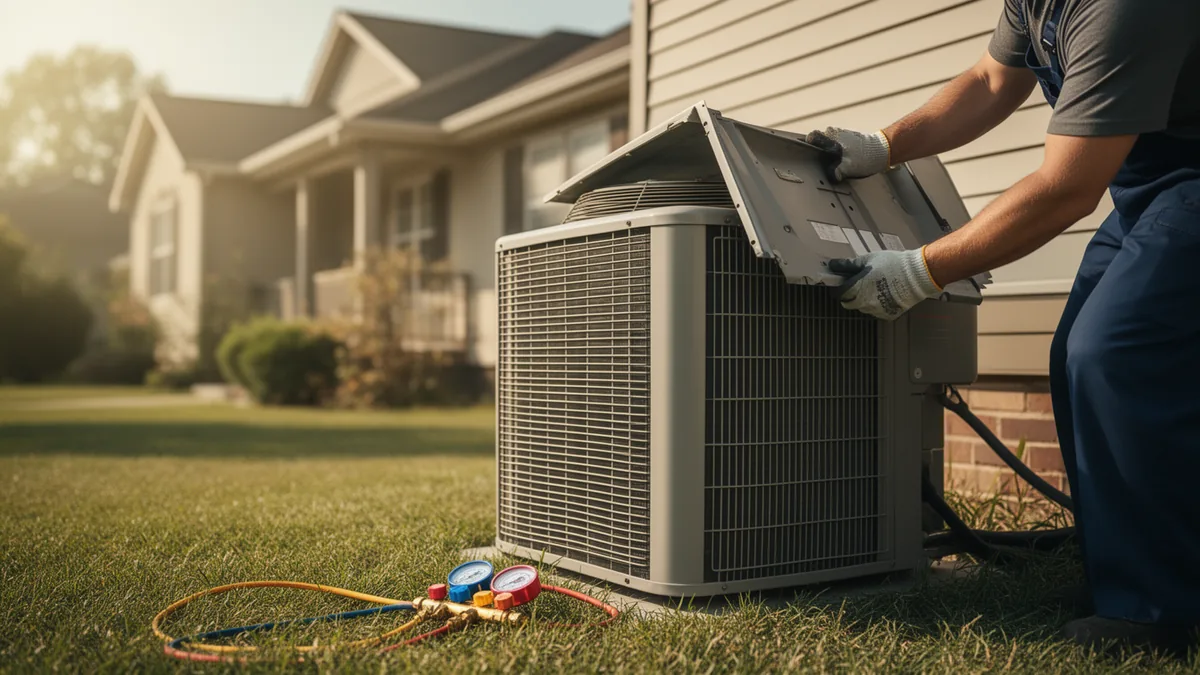
HVAC shops do not have a call-volume problem. They have a call surge problem. The first 90°F week and the first freeze each bring five days of nonstop ringing, and callers who reach voicemail book with whoever picks up next. DispatchLine is an HVAC answering service run by an AI agent. It answers the forwarded line around the clock, tells every caller up front that it is an automated assistant, and works your rules in order: safety first, then emergencies, then booking.
Emergency triage, HVAC edition
- No heat is an emergency keyword out of the box, and with an infant, an elderly person or someone on medical equipment in the home the call is an emergency even when the caller never uses a keyword: by default, the earliest emergency slot and an on-call alert.
- No cooling or no AC: also emergency keywords by default, with the same action. You can remove them outside heat season, and the vulnerable-person rule still covers those calls.
- Furnace out with a gas smell, smoke or a burning odor: leave the building and, from outside, call 911 or the gas utility’s emergency line before anything else. Details come after.
- Carbon monoxide alarm: leave the house, call 911, then details for you.
- Water around the air handler or furnace: switch the system off at the thermostat, then details.
- Frozen coil or ice on the line set: if your business facts say so, the caller is told to set the system to off so the coil can thaw.
- Suspected refrigerant leak (hissing, oily residue, ice): no diagnosis. It records what the caller sees and books a diagnostic visit in an open window under your rules.
The agent gives one safety instruction first: a built-in one for gas, smoke, carbon monoxide or water at the unit, or one you added in your own words. If your facts say no-heat callers may confirm the thermostat is set to heat and the furnace breaker is on, it suggests exactly those checks. You change your emergency keywords, the emergency action and the transfer number in the portal without a ticket, and the emergency triage page has the details. The vulnerable-person rule is built in and always on.
Routine work
Tune-ups, filter service, maintenance-plan visits, thermostat installs, duct cleaning, replacement quotes. The agent books routine work into the arrival windows on your board under your scheduling rules, keeps replacement inquiries that do not book as leads for your comfort advisor, and answers only from the business facts you wrote: service area, hours, brands, the Sunday surcharge. Anything else: the office will confirm that.
Maintenance plans and the diagnostic fee
Tell the agent what your plan includes and costs. It answers plan questions from those facts. Add a triage question such as “are you on our maintenance plan?” and the agent asks it, and the answer is on the call record so your office can follow up. The diagnostic fee works the same way: if you wrote it into your facts, the agent answers price questions with it, in your words. If you did not, it says the office will confirm pricing.
The triage questions it asks
Out of the box an HVAC line asks four questions: the caller’s name, the service address, whether it is heating or cooling and whether the system is completely off or just not keeping up, and whether there is any smell, noise or water around the unit and how old the system is. The list below is a fuller set you can add in the portal, and the agent asks your questions in order. Getting a name, phone number and address before it books is built in.
- Does anyone smell gas, see smoke, or hear a carbon monoxide alarm? If yes: leave the building and, from outside, call 911 or the gas utility’s emergency line.
- Is it no heat, no cooling, or something else, such as a noise, a leak or a blank thermostat?
- Who is in the home: infants, elderly, anyone on oxygen or other medical equipment?
- Roughly what is the temperature inside, and outside?
- Is the thermostat showing anything, and is it a furnace, a heat pump, a boiler or central air?
- Is there water around the indoor unit, or ice on the outdoor unit or the copper lines?
- Is the address in your service area, and is the caller the owner, a tenant or a property manager?
- Has your company been out before, and is the caller on a maintenance plan?
- Name, phone number and address, before it books anything.
A sample no-heat call
Cedar Ridge Heating and Air is a fictional two-truck shop, closed on Sundays, and this call comes in at 5 p.m. on a Sunday. Riley is the default agent name. The shop added the gas and thermostat questions from the list above and wrote its own after-hours fee sentence.
Riley: This call is answered by an automated assistant and may be recorded. Thanks for calling Cedar Ridge Heating and Air, this is Riley. How can I help you today?
Caller: Our furnace stopped and it’s 20 degrees out. We’ve got a newborn.
Riley: Before anything else, do you smell gas anywhere in the house, and is your carbon monoxide alarm quiet?
Caller: No gas smell. The alarm’s quiet.
Riley: Good. I’m treating this as an emergency. Is the thermostat showing anything?
Caller: It’s on, but nothing’s happening. Wait, are you a real person?
Riley: I’m Cedar Ridge’s automated assistant. I can book this now, or have someone from the office call you back. Which do you prefer?
Caller: Just book it.
Riley: Can I get your name, the best number to reach you, and the address?
Caller: Dana Whitfield, 555-0142, 218 Larkspur Lane.
Riley: Thank you, Dana. That’s 555-0142 and 218 Larkspur Lane. The earliest emergency window is tonight between 7 and 9. There’s a $125 after-hours diagnostic that goes toward the repair. Should I book it?
Caller: Yes, please.
Riley: Is it okay if I text the appointment confirmation to this number? You can reply STOP any time to stop the texts.
Caller: Yes.
Riley: Booked for tonight between 7 and 9. A technician will call you back within 15 minutes. Thank you, Dana.
About a minute later the recording, transcript, short summary and outcome are in the portal, and you have the booking by email.
Why HVAC shops miss calls
Invoca, a call-tracking company that also sells AI voice software, reported in July 2026 that 52% of calls to the home-services businesses on its platform, HVAC among them, were answered by a person (Invoca, 2026). That is their data, not ours. What makes HVAC harder is that its missed calls arrive in bursts. Your office has one pair of hands, your techs are in attics and on roofs, and during a call surge the second caller gets voicemail. A homeowner in a 90°F living room does not leave a message. They call the next shop, and the shop that answers first wins the job.
After-hours HVAC calls miss for a different reason. The on-call tech is driving, asleep, or in a crawl space, and the forwarded ring lands on a cell phone voicemail. The after-hours HVAC calls guide covers the on-call setups that work.
The HVAC calendar
- The first 90°F week. No-cool calls stack up from condensers nobody tuned, and heat advisories put elderly callers at the top of the list. The heat-wave playbook is written for that week.
- The first freeze. Furnaces that have not fired since spring, heat pumps stuck in defrost, and no-heat calls with infants in the house. The first-freeze playbook covers the triage rules.
- Shoulder seasons. Tune-ups, plan renewals and replacement quotes. The replacement lead is the most valuable call of the year, and it arrives when you are answering the phone yourself from the road.
Your greeting and triage questions can change with the season, a heat wave script that asks about vulnerable people first, a freeze script that asks about space-heater use. You switch it yourself in the portal.
What a missed tune-up costs versus a missed replacement
Put your own numbers in. Say a tune-up is $129 and an installed replacement averages $9,000. In a shoulder-season week you miss six calls. If four were tune-up calls and half would have booked, that is two tune-ups, $258. If one of the six was a homeowner asking what a new system costs, and you close one such lead in four, the expected value of that one voicemail is a quarter of $9,000, which is $2,250. The tune-up caller comes back in the fall. The replacement caller signs with the shop that answered.
Now the surge. Say the first 90°F week brings 40 calls a day instead of 15, and your office answers 15. That leaves 25 a day, 125 for the week. If a third would have booked a $150 diagnostic, that is about 42 diagnostics, roughly $6,250. That is an illustration; run your own numbers through the missed-call calculator.
Against that, One Truck is $149 a month, flat. As an illustration only, the fair-use guidance for One Truck, 800 answered minutes a month, is roughly 267 to 400 calls of 2 to 3 minutes each, which is useful for sizing a plan and is not a bill: there is no per-minute charge. On the numbers above, one recovered replacement lead covers about fifteen months of One Truck, and one closed replacement covers about five years.
How the free trial and the plans fit a two-truck shop and an eight-truck shop
The trial is the same site-wide and open to any US shop: no application, and no approval to wait on. You sign up, run a 15-minute setup wizard that takes your greeting, hours, service area and emergency action, add your brands and the after-hours fee sentence in the portal, and start with a card on file. Nothing is charged until the trial ends, and you can cancel from your billing page before then. Canceling during the trial ends it at once and the agent stops answering. Your line starts answering only after your own test call, so you hear it handle a no-heat call before a homeowner does. The trial runs 3 days and 150 minutes, with up to 8 minutes on any one call, and when the minutes are gone the agent says the line is paused instead of running up a bill. Setup help comes by email from support@getdispatchline.com, with a reply inside one business day.
Two trucks: after hours only
Forward the line at 5 p.m., take it back at 7 a.m. For emergencies you choose one action in advance: book the emergency slot and alert the on-call tech, live-transfer to a number you set, or take details and promise a callback within 15 minutes. One Truck, $149 a month with no per-minute charge, is where a two-truck shop lands.
Eight trucks: overflow during a surge, then full time
Forward on busy and no-answer, and the office keeps first pick of every ring while the agent takes the calls the office cannot reach. Eight trucks is Fleet, $549 a month, flat, for seven or more trucks or more than one location. A second location is covered by Fleet too, with no per-minute charge, and our team sets up the locations with you. Every plan has every call-handling feature.
Plans are month to month and begin when the trial ends unless you cancel first, and you can cancel renewal any month from the billing page. There is no per-minute charge on any plan. The first-month guarantee is on the refund policy page and the plan comparison is on the pricing page.
What the agent will not do
- Quote a price you did not write.
- Diagnose or promise a fix. It records symptoms; your tech decides.
- Promise a time that is not booked on the board.
- Take a payment or a card number.
- Text a caller who did not agree to a text on the call.
- Claim to be human. Asked, it says it is your automated assistant and offers a callback from a person.
- Push data into Jobber or Google Calendar (both in development), or into Housecall Pro or ServiceTitan (planned). Today the appointments live on the portal board, call history exports to CSV, and a weekly report comes by email.
Where an HVAC answering service fits next to your dispatcher
The honest version: during a surge, your dispatcher’s real job is sequencing trucks: who is closest, who has the part on the van, which no-cool call has an infant in the house. Every minute spent taking a name and an address is a minute not spent routing. The agent takes the intake, applies your emergency rules, and puts the call on the board. The dispatcher sends the trucks. In a two-truck shop the dispatcher is you.
So when you compare HVAC dispatch services, ask which half you are buying. Assigning the tech, routing the trucks and reshuffling the board is dispatch; answering, triage and booking the call into a window is intake. DispatchLine does the intake half and leaves the routing to your dispatcher.
If you have a full-time dispatcher who picks up every ring within three rings, you do not need an AI receptionist for HVAC during the day. Where it earns its place is after 5 p.m., on weekends, and in the two weeks a year when the phone doubles.
A traditional answering service takes a message and pages you. The agent triages by your rules, gives the safety line, answers the questions you wrote, and books into your windows. If you already pay for one, keep it live through your trial and compare the logs; the answering service comparison shows where each one wins.
Five questions to ask any answering service for HVAC companies
Price is the least useful number on the page. Ask these five of every service you shortlist, this one included.
- What happens when thirty people call in the same hour? A live call center answers calls in a line, so during a regional heat event your callers wait behind other companies’ callers. An on-call tech answers one and misses twenty-nine. An automated agent answers them at once, because there is no line.
- Does it book, or does it take a message? A message is a task on your desk tomorrow morning and a round of phone tag; an appointment inside a window you defined is revenue. Ask what stops it booking a fifth job into a day that holds four, or a job outside your service area. DispatchLine offers only the windows your hours and board show as open, and tells callers outside your area that you do not cover them. The one exception to your hours is an emergency on a day you are closed, which can book a window between 7 a.m. and 9 p.m.
- Who decides what counts as an emergency, and by what rule? No heat at 15°F in a house with an infant is a tonight call. No cooling at 78°F in October is a Thursday call. The rules should be yours, and they should change with the season.
- How am I billed, and what counts as billable? Get in writing the rate, the per-call minimum, whether hold time, spam and wrong numbers bill, the setup fee, the term and the overage rate, then model the bad month, not the average one. DispatchLine: $149, $299 or $549 a month, by how many trucks you run. No per-minute charge, no minute bundle to run out of, no setup fee. Taxes where applicable.
- Can I hear the calls, and who owns the data if I leave? Ask for recordings or transcripts you can read, and read them for the first two weeks. Check what the recording announcement says, since consent rules differ by state, and what happens to your records the day you cancel. With recording on, which is the default, each DispatchLine call leaves a recording, a transcript and a summary in your portal, and call history exports to CSV.
The sixth question: what does it say to a maintenance agreement customer?
Priority scheduling is the main thing you sell with a maintenance agreement, so a line that cannot recognize a plan member at 9 p.m. breaks that promise at the moment the customer tests it. DispatchLine asks the caller once you add that question to your triage list, and the answer is on the call record, which is often enough if somebody reads that note first thing in the morning. More in selling a maintenance agreement on an inbound call.
Night calls that should not roll a truck
A condensate float switch tripped by a clogged drain line, a tripped breaker, a filter unchanged since March, a thermostat with dead batteries: asking about those before dispatching saves the callout. For a no-heat call at midnight, the first question to add is whether anyone in the home is at risk from the cold. Then come the checks in your business facts, the only ones the agent suggests, and then the first morning slot, with an on-call alert when your emergency keywords or the vulnerable-person rule make it an emergency.
Three answers point at a frozen coil: the outdoor unit is running, there is ice on the lines, and airflow has been weak for a few days. The agent records what the caller describes and does not diagnose. Nothing useful happens until the coil thaws, so the honest answer at 9 p.m. is the thaw instruction you wrote (system off, or fan only) and a morning booking.
What good answers sound like
Beyond the five, good answers include a defined path for when the on-call tech does not answer, and texts that go out only with permission and carry a STOP instruction, per our SMS terms. The red flags are a vendor who will not let you test the live service, one who claims its agent is indistinguishable from a person, and one who cannot describe what happens when caller number six rings during a storm. On DispatchLine, if a live transfer to your on-call number does not connect, the agent takes the details and says a technician will call back within 15 minutes.
How to test before you switch
Shortlist two services and give both the same five test calls on one afternoon: a normal booking, a no-heat call, a gas smell, a price question and a messy call on a bad connection. Compare what landed in the calendar and how fast the alert reached a phone. The DispatchLine demo line, (973) 791-7808, answers as a fictional plumbing company.
The low-risk start is to run it as an HVAC after-hours answering service first: forward the line at close, and during the day forward only on busy and no answer, so your own line rings first and only the overflow moves. A carrier code undoes it; the codes are in the Knowledge Center, and the heat-wave and freeze walkthrough is in HVAC call overflow.
FAQ
Can it tell callers which brands we install?
Yes, from your business facts. It will not recommend a system or size one.
What about commercial rooftop calls?
Add a triage question for the building name and access instructions and the agent asks for them. Commercial calls book into the same arrival windows as residential ones.
Does it handle the after-hours surcharge conversation?
Yes. You write the sentence once (“There’s a $125 after-hours diagnostic that goes toward the repair”) and the agent uses it when the fee comes up.
What does it say when a caller smells gas or the CO alarm goes off?
Leave the building and, from outside, call 911 or the gas utility’s emergency line, before anything else. It takes details only after the caller is out.
Will it tell a caller to check the thermostat or the breaker?
Only the checks you wrote into your business facts, such as confirming the thermostat is set to heat and the furnace breaker is on. It never walks anyone through a panel, a flame sensor or a gas valve.
Does the customer get a text confirmation?
Yes, text confirmations are included. They come from one shared DispatchLine messaging number that names your business, and go only to callers who agreed to a text on the call. The caller hears the arrival window on the call as well, and your booking alert comes by email.
When does the number start answering my calls?
After your test call. We buy the local number as soon as the setup wizard is done, then you press Test call and the agent phones you. When that call ends the number starts answering and the forwarding steps unlock, so nothing reaches a customer until you have heard it yourself.
Does it speak Spanish?
Not today. The agent answers in English only, in one of four American English voices. Answering Spanish-speaking callers has a routing plan you can set up this week.
Can I listen to calls live?
No. The portal does not let you listen while a call is in progress. When recording is on, the recording, transcript and two-line summary are in the portal about a minute after the call ends, and you can play the call back there. If you want a person on emergency calls, set the emergency action to live transfer to a number you choose.
Guides for HVAC companies
- HVAC Maintenance Agreement: What to Include and ChargeWhat a residential and commercial HVAC maintenance agreement covers, how many visits to include, tier pricing math, and the renewal and…
- An HVAC Phone Script for a Heat-Wave MondaySurge triage, capacity arithmetic, the waitlist and the backfill: what changes on the hottest Monday of the year when every call is a…
- Heat-wave playbook for HVACSet up your line for an HVAC heat wave call surge: what to change in DispatchLine the day before, what to watch during the week, and what…
New field guides by email
Guides for home-service businesses on answering calls, call triage and after-hours coverage: the title, a short summary and a link for up to six of the newest guides on this site. At most one email every 30 days.