Roofing answering service for storm week
Forward your line after hours, on weekends, or when a storm buries the office in calls.
3 days free, then from $149 a month. Cancel before day 4 and nothing is charged. During the 3-day trial: 150 minutes, up to 8 minutes per call. Call the demo line: (973) 791-7808
DispatchLine answers your roofing line around the clock, tells a homeowner with water coming in to stay off the roof and catch the drip, separates active leaks from missing shingles and inspection requests, and books your estimators in order of urgency into the windows on your board. It never estimates and never discusses coverage. That part stays with you.
A hail cell crosses the county at 6 p.m. By 7 the phone is ringing, and it does not stop for two days. Every call is a job. Most ring through to voicemail while you are on a ladder, and the homeowner who hung up on your greeting is dialing the next number in the results.
What an AI receptionist for roofers handles
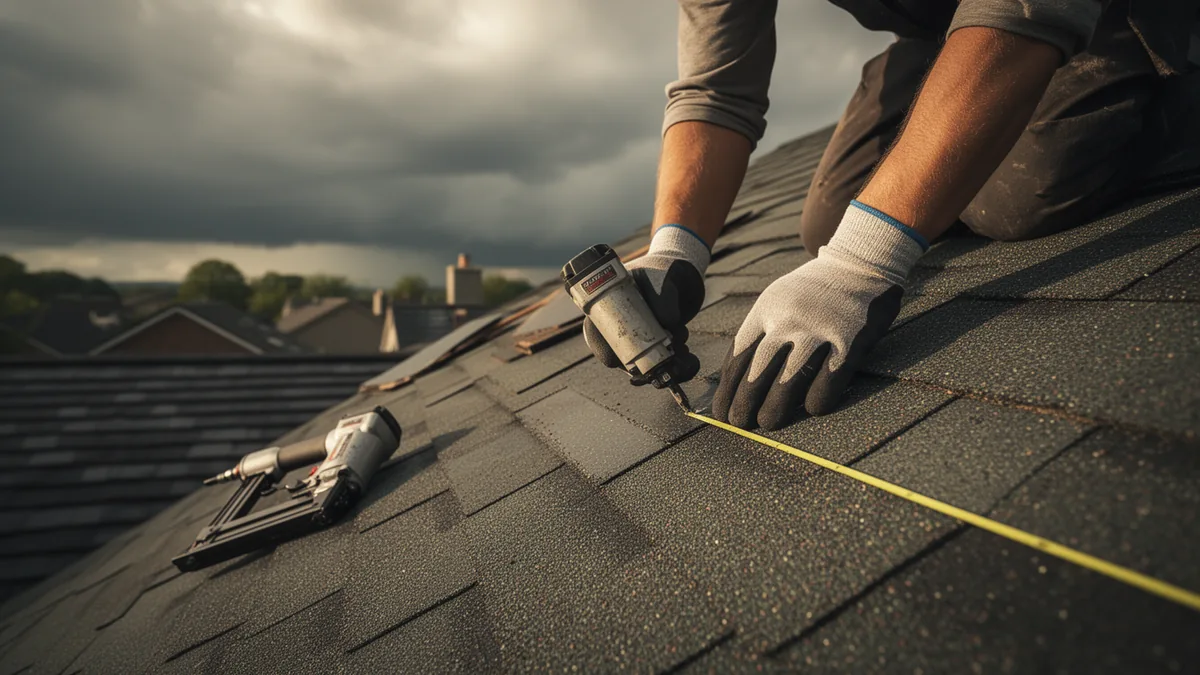
The agent answers your forwarded line, sorts the call, and books it into an arrival window on your board. The sorting is the hard part, because storm damage calls arrive in a pile that holds four different jobs.
Emergencies, and what the agent tells the caller first
- Active leak. Water is coming in now. One safety instruction first: stay off the roof, move belongings out from under the drip, put something down to catch the water. Then it books the earliest open window for a tarp or dry-in and alerts your on-call crew.
- Tree or debris through the roof. Same instruction. If you want it to ask whether anyone is hurt, add that question in the portal. Smoke, fire or a CO alarm gets “leave the building and call 911” before anything else. A smell of gas gets “leave the building and call the gas utility’s emergency line from outside.”
- Water through a ceiling fixture. If you want callers told to switch it off at the breaker, write that as a business fact and the agent says it in your words. It gives no electrical instruction you did not write.
- Commercial flat-roof leak. A property manager with water over a tenant’s inventory. An emergency when your emergency rules say so.
Routine, booked into a regular window
- Missing or lifted shingles with no water inside yet
- Roof inspection requests after a storm, a home sale or a letter from the carrier
- Gutter, fascia and downspout calls, including sections pulled loose by ice
- Skylight, flashing and chimney leaks that only show in heavy rain
- Re-roof quotes and full replacement leads
- Insurance claim documentation, where a claim number and an adjuster date already exist
By default an emergency gets the earliest open window. The roofing defaults also treat a mention of “storm damage” as an emergency, so a storm call with no water inside is handled as one until you take that phrase out of your emergency keywords in the portal. Routine goes to the next open inspection window you defined in arrival windows and hours. That is how your estimators’ week gets built in order of urgency while you are on a roof. The after hours answering service page covers the rules and the actions you attach to them: alert the on-call tech, live-transfer to a number you choose, or promise a callback.
The questions it asks before it books
Name, phone and address come first. Then it works down a list you can edit in the portal. Out of the box it asks the first question below, whether this is storm damage, and whether the roof is shingle, metal or flat. Add the others and it asks them too:
- Is water coming in right now, and where?
- Did it start with last night’s storm, or has it leaked before?
- Is the water near a light fixture, an outlet or the panel?
- Residential or commercial? If commercial, who is the property manager and the tenant contact?
- Roof age and material, if known
- Has a claim been opened, with which carrier, and is an adjuster visit scheduled?
- Roof access: locked gate, dogs, steep pitch, second story with no ladder set
All of it lands on the call in the portal with the two-line summary about a minute after the call, plus the recording and transcript while recording is on (the default). Your estimator reads it in the truck and knows whether to bring a tarp roll or a measuring wheel.
A storm-week call, start to finish
Northfork Roofing is fictional, Riley is the default agent name, and Northfork added the fixture and gate questions to its list. The recording line plays whenever recording is on; you can turn recording off in the portal, but not the announcement on its own.
Riley: This call is answered by an automated assistant and may be recorded. Thanks for calling Northfork Roofing, this is Riley. How can I help you today?
Caller: The storm last night tore some shingles off and now there’s a drip in the upstairs bedroom.
Riley: Sorry to hear that. Put a bucket under the drip and, if you can safely, move anything valuable out from under it. Stay off the roof; the decking may be soft. Is the water near a light fixture or an outlet?
Caller: No, it’s by the closet.
Riley: Good. Can I get your name, the best number to reach you, and the address?
Caller: Dana Morales, 512-555-0142, 41 Larkspur Lane. Should I call my insurance?
Riley: That’s a question for the estimator and your carrier, and I’ll note that you asked. Let me read your details back: 512-555-0142, 41 Larkspur Lane. Water coming in is an emergency, so the earliest emergency window is tomorrow between 9 and 11, for a tarp and inspection. Does that work?
Caller: Yes. Are you a real person?
Riley: I’m Northfork’s automated assistant, and I can have the office call you back if you’d prefer. Is it okay if I text the appointment confirmation to this number? You can reply STOP any time to stop the texts.
Caller: Yes, text me.
Riley: You’re on the board for tomorrow, 9 to 11, emergency tarp and inspection, and a technician will call you back within 15 minutes. Anything the crew should know, like a locked gate or a dog?
Caller: Side gate, not locked.
Riley: Noted. If it gets a lot worse tonight, call this number again. Thanks, Dana.
Behind that call: the appointment is on the board, the on-call estimator has an email with the address and a summary of the call, and the recording, transcript and summary are in the portal about a minute later. Owner SMS alerts are optional and need opt-in and program approval.
Why roofers miss calls in the week they can least afford to
Your phone is quiet in February and unanswerable in May. Hail season on the Front Range and across Texas and the Plains runs spring into early summer. Derechos hit the Midwest in summer, hurricanes lift shingles along the Gulf and the Carolinas into fall, and ice dams do it in the Northeast in winter. Whatever your region, the calls arrive in a pile, and your crews are on roofs when it lands.
Then the storm chasers arrive, knocking doors in your zip codes within a day of the hail. The homeowner knows you and not them, but they called you first, got voicemail, and the door knocker was on the porch. The shop that answers books the inspection, and the inspection is where the replacement gets sold.
Most published missed-call figures come from companies that sell answering products, and none we found breaks out roofers. A storm week is the test: count what rang through to voicemail. Call answering closes the gap: the line is picked up, in your greeting, every hour of the week.
What it costs against what one missed roof costs
Put your own numbers in. The shape of the answer does not change.
A missed repair. Say your average storm repair is $650, you miss five calls in a normal week, and one in three would have booked. That is about 1.7 jobs, call it $1,100 a week, and a little over $4,500 a month that went to whoever answered.
A missed replacement. Say your average full replacement is $12,000 and you keep 30 percent after materials, labor and dump fees, so $3,600 stays with you. One replacement lead a month that booked with the door knocker instead is $3,600 gone. One Truck is $149 a month, so one saved replacement covers about two years of it.
A storm week. Say 200 calls land in 48 hours and your office and crews answer 60, leaving 140. If a quarter would have booked an inspection, that is 35 inspections. If one in three signs, that is about 12 jobs at $12,000, roughly $144,000 that rang through to voicemail from one storm. Halve every assumption and it is still five figures. The missed-call calculator runs this on your own ticket, miss rate and close rate.
The plans
| Plan | Monthly | Built for | Per-minute charge |
|---|---|---|---|
| One Truck | $149 | 1-2 trucks | None |
| Crew | $299 | 3-6 trucks | None |
| Fleet | $549 | 7+ trucks or more than one location | None |
Every plan has every call-handling feature; Fleet adds several locations, set up with our team. Plans are month to month and start on day 4 of your trial unless you cancel first; cancel renewal any month from the billing page. As an illustration only, the fair-use guidance for One Truck, 800 answered minutes a month, is roughly 267 to 400 calls of 2 to 3 minutes each, which is useful for sizing a plan and is not a bill: there is no per-minute charge. Those 200 storm-week calls at 3 minutes are about 600 answered minutes. On a flat plan a second storm in the same month costs nothing extra, which is the month that decides whether coverage was worth buying. Full detail is on the pricing page, and the first-month guarantee is described in the refund policy.
The free trial and the paid plans for a two-crew shop and a regional company
The current offer is a 3-day free trial, open to any US roofing company, with no application and no approval to wait on. You sign up, run a 15-minute setup wizard that takes your greeting, hours, service area, inspection windows and emergency rules, and start with a card on file. Nothing is charged until day 4, and canceling from your billing page before then costs nothing. Canceling during the trial ends it at once and the agent stops answering. We build the agent and buy you a local number, then you press Test call and the agent phones you; once that call is done the number starts answering and the forwarding steps unlock, so you hear it work before a homeowner does. The trial covers 150 minutes, a call can run up to 8 minutes, and when the minutes are gone the agent says the line is paused instead of running up a bill. Setup questions go to support@getdispatchline.com and are answered inside one business day.
Two crews, three trucks, you on one of them. Forward on no-answer during the day and full-time after 5 and on weekends. If you go on, Crew (three to six trucks) covers a normal month and a storm month costs exactly the same, because there is no per-minute charge.
Regional, eight trucks, an office of two. Forward on busy and no-answer so the agent takes overflow when both office lines are lit, and forward everything after hours. Fleet is the plan for seven or more trucks, and a storm season costs the same as a quiet one; a second branch is also what Fleet is for, and our team sets up the locations with you.
Storm-week edits are yours without a ticket: extend your hours, add a fact that you are tarping only in three zip codes until Friday, and the agent uses it from the next call. Scheduling explains how windows and the board work together.
What the agent will not do
It books the inspection. It does not run it.
- It will not estimate. It does not price a square, a tear-off or a tarp, and it quotes no price you did not write into your business facts.
- It will not discuss insurance coverage. Approval, deductibles and what the carrier pays belong to the estimator and the adjuster. It says what you wrote, for example “we work with all carriers and can meet the adjuster”, and the call summary notes a claim the caller mentions.
- It will not diagnose. It does not tell a homeowner whether the roof needs replacing or whether the damage is hail.
- It will not promise a time that is not on the board. If tomorrow’s tarp windows are full, it offers the next open one.
- It will not take a payment or a card number, and it texts no one who did not agree to a text on the call.
- It will not claim to be human. Asked, it says it is your automated assistant and offers a callback from a person.
- Anything outside your facts gets “I’ll have the office confirm that.” Writing good business facts covers what to put in.
Alongside your office, a dispatcher, or the roofing answering service you already pay
If an office manager answers every call from 7 to 5, you do not need this during the day in a normal week. You need it at 5:01, on Saturday, and in the storm week when she has four lines lit. Forward on busy and no-answer and the agent takes what she cannot, in your greeting, with your rules.
A roofing answering service takes a message and sends it to you. In storm week that is the problem: you now have 140 messages to return, and by the time you return them the homeowner booked the shop that picked up. The agent books the inspection while the caller is on the line, and the lead sits in the portal with a one-tap callback. The trade-offs are laid out in AI receptionist versus answering service.
Every call and its outcome, plus its recording, transcript and summary while recording is on, the appointments board and the lead list are visible to unlimited team members, with a report email every Monday.
FAQ
Can it book a free roof inspection?
Yes. It takes the caller’s name, phone and address, then books an open arrival window from your board; an active leak is an emergency and by default gets the earliest open window instead.
Does it handle commercial flat-roof calls?
Yes. Add a question in the portal asking whether the property is residential or commercial and who the property manager and tenant contact are, and the agent asks it. It books an open arrival window from your board, as it does for any call. Whether a commercial leak counts as an emergency is your rule.
Will it tell a homeowner whether insurance will cover the roof?
No. It does not discuss coverage, deductibles or whether a claim will be approved. If the caller mentions a claim or a carrier, the call summary notes it, and the rest is left to your estimator and the adjuster.
Does it text the homeowner a confirmation?
Yes, text confirmations are included, sent from one shared DispatchLine messaging number that names your business and only to callers who agreed to a text on the call. The booking is on your board either way, and the alert to you goes by email.
Does it stop robocalls during storm week?
With spam screening on, it hangs up on robocalls, and a screened robocall counts as one minute. A live person pitching your business, such as someone selling storm leads, hears “Thanks, we’re not interested” and the call ends; it is marked spam and stays off your lead list.
What happens when several homeowners call at once after a storm?
The agent answers them at the same time rather than in a line. There is no hold queue, so no caller waits on music while the first one finishes. Forward on busy as well as no-answer, and a caller who rings while you are already on the phone reaches the agent instead of a busy signal or your voicemail.
Does it work with my roofing CRM or calendar?
Not yet as a live connection. Google Calendar sync and a Jobber connection are in development, and Housecall Pro and ServiceTitan are planned. Today you work from the portal board, the CSV export of your call history and the Monday report email.
When does the number start answering my calls?
After your test call. As soon as the setup wizard is done we build the agent and buy a local number, and you press Test call so the agent phones you. When that call ends the number starts answering and the forwarding steps unlock, so no storm-week caller reaches it before you have heard it yourself.
Does it speak Spanish?
Not today. The agent answers in English only, in one of four American English voices. Answering Spanish-speaking callers has a routing plan you can set up this week.
Can I listen to calls live?
No. The portal does not let you listen while a call is in progress. When recording is on, the recording, transcript and two-line summary are in the portal about a minute after the call ends, and you can play the call back there. If you want a person on emergency calls, set the emergency action to live transfer to a number you choose.
New field guides by email
Guides for home-service businesses on answering calls, call triage and after-hours coverage: the title, a short summary and a link for up to six of the newest guides on this site. At most one email every 30 days.