AI Receptionist for a Garage Door Company
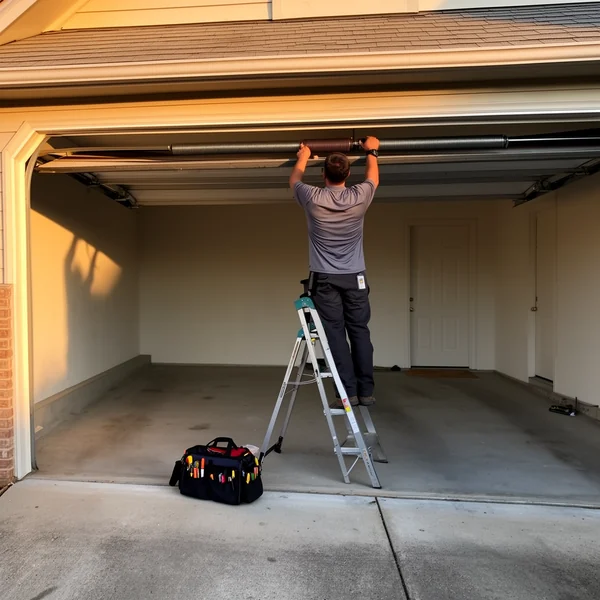
A garage door shop’s phone has a shape you can set your watch by. It starts at about ten past seven, when people go out to leave for work and the door will not open with the car behind it. It goes quiet mid-morning while your techs are working. It comes back at five thirty, when the second wave gets home to a door that will not close and cannot be left open all night.
Both of those windows are exactly when your trucks are driving or a tech is standing under a door with an opener running. Nobody hears a phone in a garage. That is not a discipline problem, it is an acoustics problem, and it is why so many of these calls end in a voicemail box nobody fills.
The calls, and what actually makes one urgent
Most trades define an emergency by damage. In garage doors it is defined by a car, and it is worth writing that down before you configure anything.
A broken torsion spring is the classic. There is a bang like a gunshot in the middle of the night, and in the morning the opener strains, clicks and gives up. If the car is inside and the customer needs it to get to work, that is an emergency at seven in the morning whether or not anything is dangerous. If the car is in the driveway and the door is down, the same failure is a normal appointment. Same broken part, different call.
The rest sorts itself quickly. A door off track or hanging crooked after somebody backed into it is urgent, because the opening is not secure and the door should not be operated. A snapped cable is the same. A door that reverses on the way down is usually a photo eye out of alignment or catching afternoon sun, which is a nuisance. An opener that does not respond at all is often a remote battery.
AI Receptionist for Garage Door Company Owners: What to Configure First
The default settings on any answering system are written for a generic service business, and they will treat all of the above as one queue. Four adjustments do most of the work.
Make “is the car stuck” a triage question. Not a nice-to-have field. It is the single question that sorts your morning, and it should sit right after the address. A trapped car with a broken spring goes to the on-call tech. The same call with the car outside goes into a normal slot.
Write the safety lines and never skip them. Three things a caller should hear before they hang up, and they cost you nothing: do not try to lift a door with a broken spring by hand, do not pull the emergency release cord while the door is up, and keep children and cars out from under a door that is crooked or hanging. Those are not sales lines. They are the difference between a service call and an injury, and an agent delivers them every single time, which is more than a rushed human on their eighth call of the morning manages.
Ask for the door, not just the address. Single or double, roughly how wide, whether there is a second door, and the brand on the opener if the caller can see it. Techs stock differently for a nine by seven than for a sixteen by seven, and knowing the opener brand before the truck loads saves a return trip.
Decide in advance what you want done with the easy fix. Some shops want the phone to walk a customer through checking a photo eye LED, on the theory that a free save today buys the new door in four years. Others want every call to become a visit. Both are defensible. Pick one and write it into the facts the agent is allowed to state, because an agent that answers only from what you gave it will do exactly what you decided rather than improvising.
Quotes need measurements, and the phone cannot take them
A new door is the money call, and it is the one most likely to be lost to a slow answer. What it needs is an appointment and a small pile of facts, not a price:
- Opening width and height, roughly, and whether it is one door or two.
- Steel, wood or composite, insulated or not, and whether they want windows.
- Whether the opener is staying or being replaced, and whether they want a belt drive because the room above the garage is a bedroom.
- Headroom and side room, which decide whether a standard track will even fit.
- Whether they are in an HOA with a color or panel style restriction.
- Whether they need it before an event, because ordered doors have lead times that are not yours to control.
The agent should not quote a door. Spring replacement is the same story for a different reason: the right spring depends on the door’s weight, wire size and length, so a number given over the phone is either a guess or a bad habit. It says the office will confirm, books the visit inside a window you defined, and texts the confirmation after asking permission. How the agent handles a call covers the sequence.
The first cold morning
There is one predictable spike in this trade that catches new shops every year. The first hard freeze of the season breaks springs. Metal that has been cycling for seven years gets cold and brittle overnight, and a batch of doors that were fine on Tuesday fail on Wednesday morning within the same two hours.
You cannot staff for that morning and you cannot call people back fast enough alone, because you will spend the day on spring changes. Run the arithmetic on that morning rather than an average day. If forty calls come in between seven and nine and you answer twelve, the other twenty-eight are choosing between you and the next result. Put your own ticket into the missed-call calculator using the spike day, not the quiet one.
Where this is the wrong purchase
If you have an office manager who answers on the second ring and knows which customers have double doors, an agent is for nights, weekends and the seven to nine rush, not for their desk. If you are mostly a builder subcontractor installing doors on new construction, your calls come from a super with a schedule and the phone is not where you lose work. And if your average job is small and you take a handful of calls a day, do the arithmetic honestly against what it costs and skip it.
What to set up this week
Write your triage rule around the trapped car. Write the three safety lines. List your arrival windows and how many spring jobs one truck can really do in a day. Load your service area, your trip charge policy and the opener brands you carry. Then forward on busy and no answer only, so your own phone still rings first, and give it a week of real calls before you touch anything else. The carrier codes are in the Knowledge Center, the general version of this setup is in booking without a front desk, and you can start the free trial and press Test call to hear it take a trapped car call. Setup is a 15-minute wizard, with support by email at support@getdispatchline.com and an optional WhatsApp chat at +1 (814) 808-0593.
FAQ
Can it tell a real emergency from a door that just needs a new remote?
It applies the rules you write. For this trade the strongest single rule is whether a vehicle is trapped, because that is what makes a customer accept an after-hours rate. Broken springs, cables and off-track doors with a car inside escalate. Remotes, keypads and misaligned sensors book into a normal slot.
Will it tell a customer how much a spring costs?
No, and it should not. The correct spring depends on the door’s weight and the existing spring’s wire size and length, so a phone quote is a guess you will have to walk back in the driveway. It says the office will confirm and books the visit.
What does it tell someone whose door will not open with the car inside?
Not to force it, not to lift a door with a broken spring, and not to pull the release cord while the door is up. Then it takes the address, the door size and the callback number, and alerts whoever is on call. Those safety lines are fixed, so they get said on the eighth call of the morning as reliably as the first.
Can it book two jobs at the same address?
Yes, and asking whether there is a second door is worth putting in the intake. Two-door houses often have two failures within a year of each other, and catching the second one on the same visit saves the customer a second call-out fee and saves you a second trip.
Does it handle the seven a.m. rush better than voicemail?
It answers calls at the same time rather than one after another, so the fifth caller at ten past seven is not listening to a recording. That is the difference that matters on a freeze morning, when a whole neighborhood’s springs let go inside the same two hours.
How do I keep my existing number?
You forward it. The number on your trucks and your magnets keeps working exactly as it does now, calls that go unanswered get picked up, and turning it back off is a carrier code away.
New field guides by email
Guides for home-service businesses on answering calls, call triage and after-hours coverage: the title, a short summary and a link for up to six of the newest guides on this site. At most one email every 30 days.